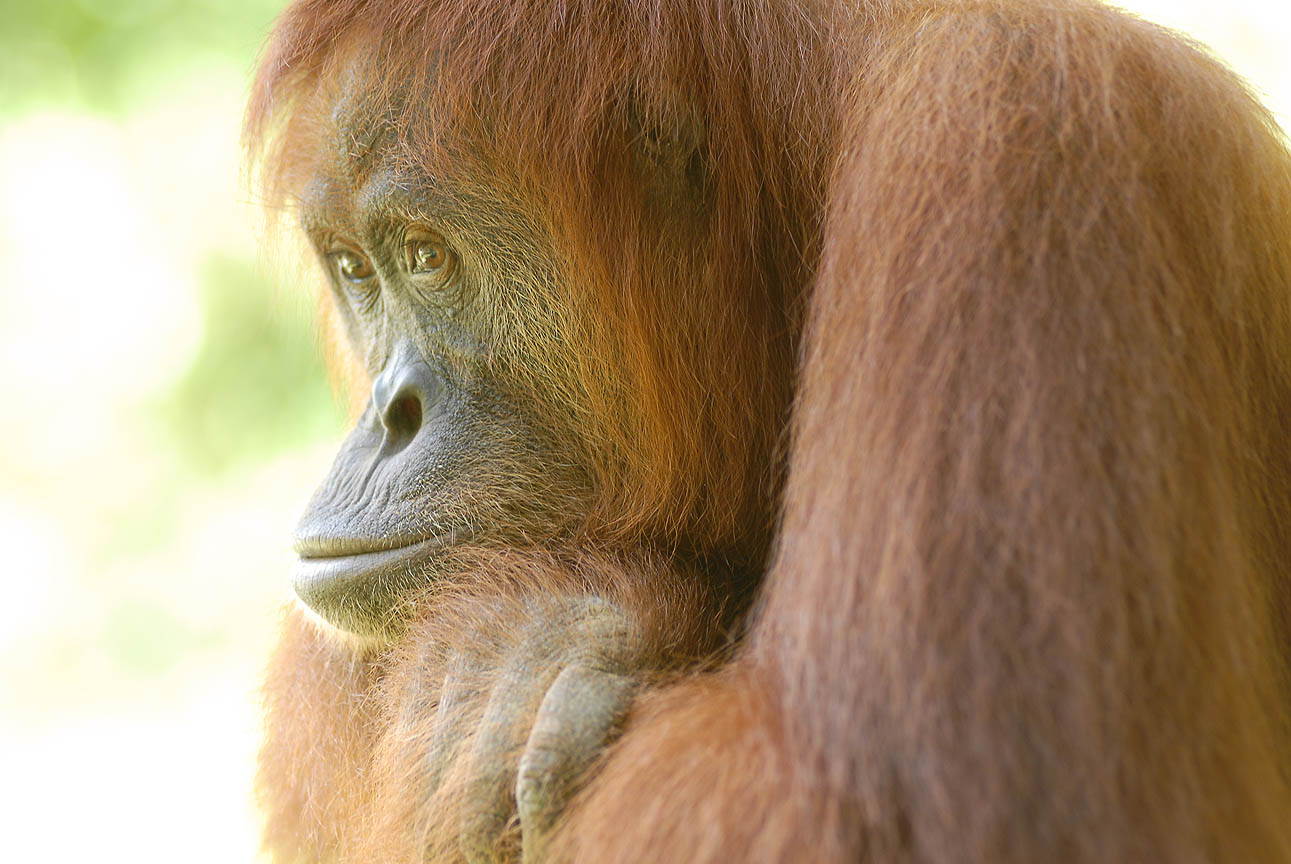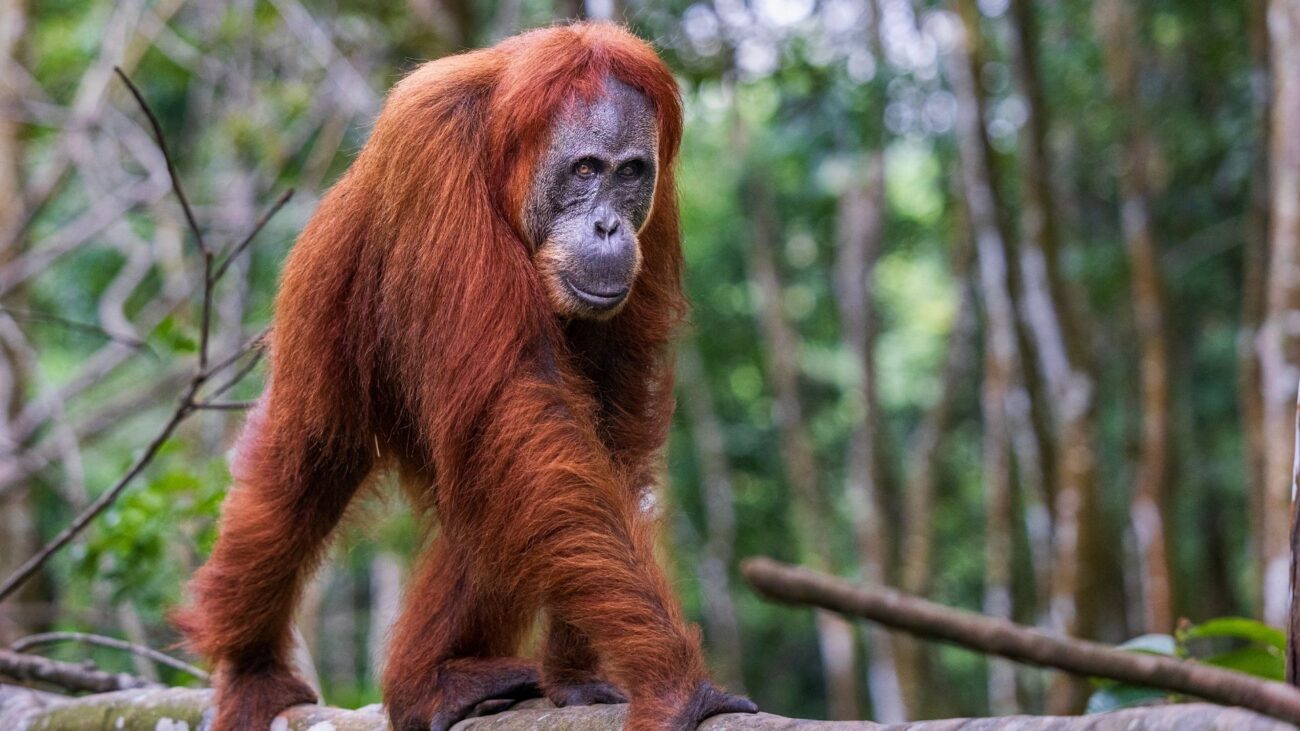
Genetics links us more closely to chimpanzees, but there are many physical traits that are unique to humans and orangutans. While these traits are indeed only found in orangutans and humans, some biologists argue that they are because of convergent evolution. This is when two species develop similar traits independently because they are useful, rather than because they inherited them from a recent common ancestor.
What do you think? Are these shared traits passed down from our common ancestor, or a fascinating example of convergent evolution?
Orangutans are the only other primates with a distinct, visible hairline, separating the face from the scalpjust like ours. While most apes have hair that blends gradually into their facial features, orangutans and humans share this clear hairline. We are also both long-haired primates (although we must admit their hair is little bit wilder than ours!).
Our reproductive biology is very similar. Both species have concealed ovulation, lacking the “sexual swellings” seen in chimps. We share high levels of the pregnancy hormone estriol, and can even use the same pregnancy tests. With a gestation of ~270 days and the longest childhoods in the animal kingdom, their investment in offspring mirrors humans.
While getting older is universal, humans and orangutans share a very specific pattern of aging, including shared vulnerabilities to complex arthritis, specific heart conditions, and sensory loss. We both experience graying and thinning hair. Just as humans lose skin elasticity, older orangutans (past-prime males) show a physical deflating of their cheek flanges.
Both species have narrow, long shoulder blades and a high cartilage-to-bone ratio in the wrists. This design provides incredible rotation and shock absorption. While orangutans use this anatomy to freely and easily move through the canopy, it allows humans to swim, throw, and reach — flexibility that knuckle-walking chimpanzees simply don’t have.
Humans and orangutans both have flat molars with thick enamel, an adaptation for crushing hard nuts and seeds. We share a single hole in the roof of the mouth. While other mammals usually have two openings here (used for sensing pheromones), our simplified, single opening reflects a shared shift toward relying more on vision than scent.
Beyond physical traits, perhaps most human of all is their laughter. When tickled, orangutans produce low-pitched vocalisations with waxing and waning rhythms that mirror human joy. Their facial expressions during play are so eerily familiar that researchers often find themselves laughing along, recognising a shared emotional complexity that transcends species.
 You can help protect Sumatra's Orangutans. Click to get updates