Photo credit: Suzi Eszterhas
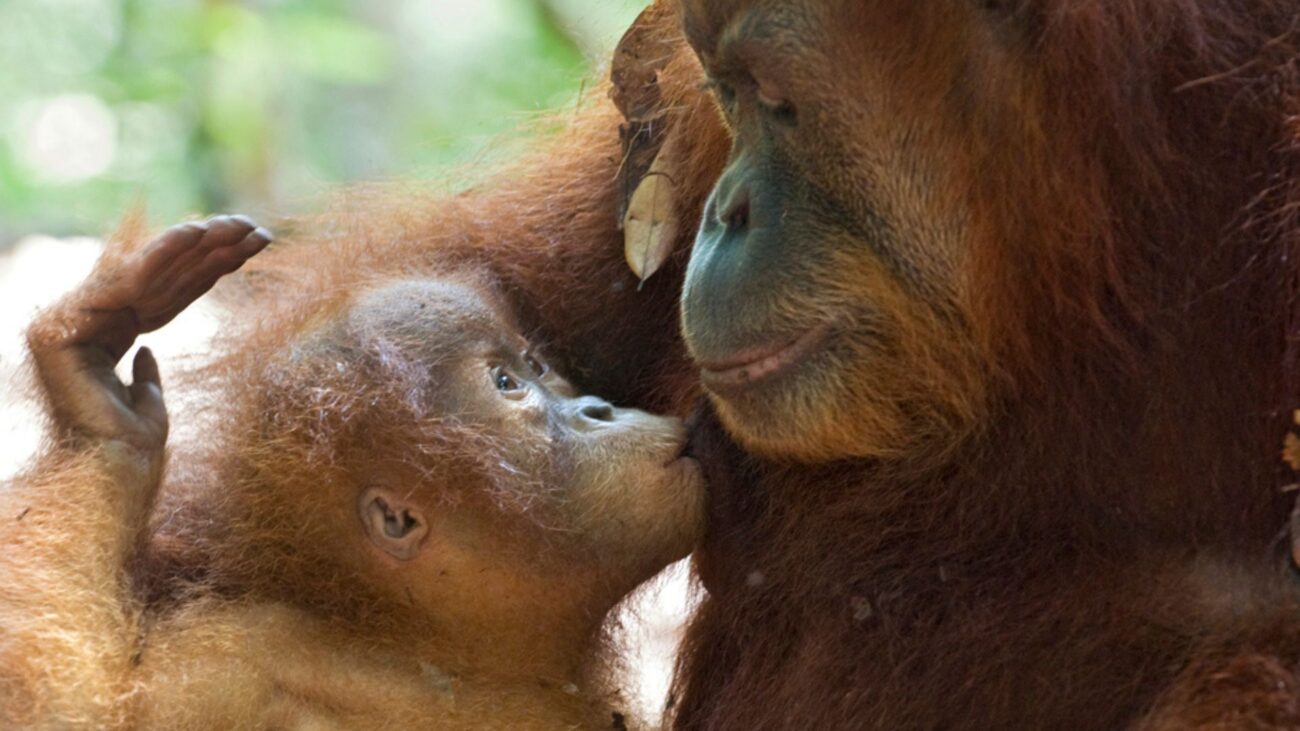
Orangutan mothers are exceptionally dedicated to their young. Babies stay with their mothers for 8 – 9 years, the longest of any nonhuman mammal. Orangutans also have the lowest infant mortality rate among mammals, with 94% of babies making it to weaning age. Researchers have found that breastfeeding has a crucial role to play.
It is very difficult to study breastfeeding in wild orangutans. They nurse their young high up in the canopy, hidden from view, and throughout the night tucked away in their nests. Additionally, young orangutans will comfort nurse without actually getting any milk (just like human babies), resulting in misleading observations.
In 2017, researchers analysed barium levels in Bornean and Sumatran orangutan teeth, to track milk consumption. The results suggested that orangutans nurse their babies for 8 – 9 years (the longest of any mammal). The mothers adjusted milk intake based on food availability, improving infant health and survival.
Now, a new study has analysed fecal proteomics (proteins in faeces) to map the breastfeeding and weaning patterns of wild Bornean orangutans. In all samples, from 2.7 – 6.5 years old, they found milk-specific proteins in faeces. This is direct evidence that Bornean orangutans continuously consume breastmilk for at least 6.5 years after birth.
Why does this matter? Prolonged breastfeeding is an important part of orangutan survival strategy, bolstering infants’ immune system and digestive health. Because their population recovery rates are naturally so low, any disruption or stress that cuts this breastfeeding period short could completely undermine the lifelong health of baby orangutans.
 You can help protect Sumatra's Orangutans. Click to get updates