To figure it out, researchers looked at hand preferences across 41 different primate species and compared them to humans. This is what they found.
Humans are the only primate species with an overwhelming right-hand dominance. Around 90% of people are right-handed. This is a population-level bias, not found in other monkeys and apes. Now, a new study offers an answer to this puzzle, suggesting right-handedness is tied to some of the key features that make us human.
Researchers analysed hand preferences in 41 primate species (with 2000 individuals). They explored many of the leading hypotheses, such as diet, social organisation, tool use, and habitat. They found that right-handedness is linked to large brain size and relative limb proportions, both of which relate to walking on two legs.
Our ancestors likely began favouring one hand more strongly when they started walking on two legs. This freed up their hands to perform other tasks, such as manipulating objects and using tools. Over time, those who excelled at fine motor tasks with one hand had a competitive advantage, so they were more likely to survive and reproduce.
Then, as human brains grew larger and more complex, the preference for right-handedness became stronger, until we had a permanent right-hand bias. If this is the case, why is 10% of the population still left-handed? It’s down to genetics and random variation, and which side of your brain is most dominant. This is determined before birth.
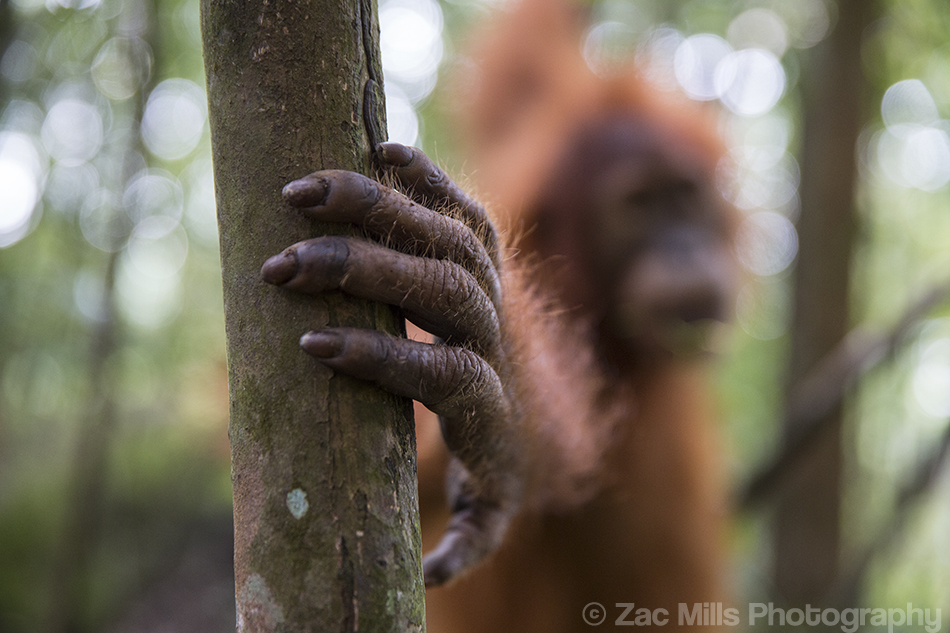
As for orangutans? It’s difficult to determine hand preference in wild orangutans, as they frequently switch between hands (and feet!) and tend to reach for branches or food with whichever hand is closest. One study in captive orangutans gave them a simple puzzle requiring hand coordination, and found the group was mostly left-handed.
 You can help protect Sumatra's Orangutans. Click to get updates